After having a big meal at the restaurant on the top of the World’s Tallest Building in Dubai, you excuse yourself from the table and go to the bathroom. Without even thinking about it, you flush the toilet. Where does the poop go? Does Burj Khalifa have a Sewage? In most places around the world, waste would be sent to a septic system and then gradually transported to a municipal wastewater treatment plant.
In more environmentally friendly buildings, it might pass through a series of filters that allow it to be reused for things like watering plants or flushing toilets. Unlike what some people believe, the Burj Khalifa has a properly managed sewage system that’s linked to Dubai’s modern sewer network. Rather than using garbage trucks to move waste, the building relies on advanced gravity-based pipes and high-capacity ejector pumps to send waste down to the city’s treatment facilities. Let indubaimall tell you everything that you ever wanted to know about Burj Khalifa skyscraper sewage system in this guide.
Burj Khalifa Sewage system: facts vs myths
Does Burj Khalifa have a Sewage? The myths of Burj Khalifa Sewage system is that you’d expect that the world’s tallest building. It is a structure that needs incredibly advanced engineering and technology to reach such heights, and it would also have a top-notch sewage system. But here’s the thing. It’s not connected to the city’s wastewater treatment system. So, when you use the bathroom in the Burj Khalifa, the waste isn’t processed locally. Instead, it’s actually taken out of the city by truck. Trucked out of the city! We’re honestly amazed by how inefficient that is. One of the most advanced buildings on the planet relies on an old-fashioned method in order to move its wastewater to a treatment plant outside the city.
So, you should keep that in your mind if you’re ever lucky enough to visit the Burj Khalifa and use its restroom, someone will have to pick up your waste and drive it out of Dubai. The rumor claims it’s not connected to the city’s wastewater treatment system, and that waste is hauled away by Dubai sewage trucks. However, Burj Khalifa sewage fact check system is that a full soil, waste, and vent system is provided, designed for gravity flow and ejector discharge to a point where it connects with the city’s municipal sewer system. Similarly, the storm drainage is also linked to the city sewer system. The Burj was constructed with plumbing and drainage systems designed to connect to the city’s public sewer system.
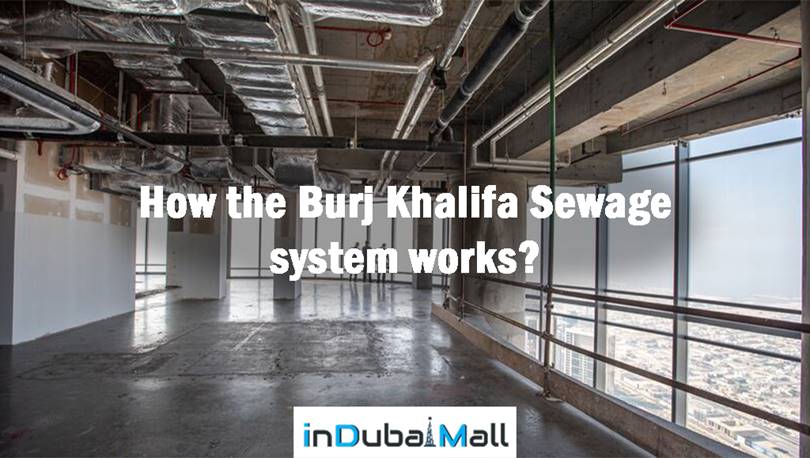
How the Burj Khalifa Sewage system works?
The Burj Khalifa uses technologies such as Membrane Bio-Reactor (MBR) units and Reverse Osmosis (RO) to treat wastewater. This treated water is then reused to keep the Dubai Fountain filled. Because Dubai has very hot weather, water evaporates quickly, and it is causing the Dubai Fountain to lose a lot of water over time. To fix this, Dubai brought in expert Hitachi engineers to find a solution.This led to the creation, at that time, of the first-of-its-kind wastewater treatment plant serving both the Burj Khalifa and Dubai Mall, and it is helping to eliminate misconceptions such as the Burj Khalifa sewage truck myth. Dubai also wanted an eco-friendly solution, as freshwater is scarce in the desert. Therefore, the Burj Khalifa provided a chance to address the following sewage systems that we will explain.
Use of gravity-fed pipes and ejector systems
The Burj Khalifa uses a carefully designed mix of gravity-fed pipes and ejector systems to handle wastewater effectively throughout its great height. On the lower and middle floors, gravity helps sewage flow down through big vertical pipes, so there’s less need for constant pumping. However, on the higher floors, where gravity alone isn’t enough to keep the water moving properly, ejector systems come into play. These systems use compressed air or vacuum to push wastewater into the main drainage pipes without causing too much pressure. This combination helps prevent pressure changes that could damage the pipes and makes sure waste is safely sent to the city’s sewer system in Downtown Dubai.



Advanced plumbing and pressure management technology
Advanced plumbing and pressure-management technology in Burj Khalifa addresses the significant challenges of water circulation and pressure control over its 160-plus floors. It incorporates several pressure-reducing stations that segment its height into zones, and it is preventing damage to pipes and fixtures from high pressure. Booster pumps provide a consistent water supply to the upper levels, while expansion tanks, control valves, and smart monitoring systems ensure balance throughout the plumbing network. For wastewater management, gravity-assisted drainage works in conjunction with ejector systems to transport sewage safely that is further disproving the Burj Khalifa sewage system hoax. As a result, these technologies have a dependable, efficient, and secure plumbing system for the tallest building in the UAE.